
Advanced diagnostic technologies allow the prostate to be studied with a precision and safety far superior to conventional techniques. In our clinic we combine state-of-the-art tools such as Fusion biopsy, multiparametric functional magnetic resonance imaging, and micro-ultrasound to obtain a much more detailed evaluation of the prostate, detect suspicious alterations and lesions more accurately and offer a personalized, precise and minimally invasive diagnosis.
In Urovinci, We are the only center in Andalusia which has all therapeutic alternatives for the treatment of hyperplasia and more advanced technologies for the diagnosis and treatment of prostate cancer.
Fusion prostate biopsy is an advanced and highly precise technique for the diagnosis of prostate cancer, which integrates in real time multiparametric magnetic resonance imaging with transrectal ultrasound to accurately locate and biopsy previously identified suspicious areas.
The technique digitally merges the MRI images with those obtained during the ultrasound. In this way, the specialist can precisely visualize the suspicious lesion and take the sample exactly from the point intended for analysis. This represents a key difference compared to conventional biopsy, where sampling is performed in a more random manner and, at times, may not coincide with the affected area.
This procedure significantly increases diagnostic reliability and reduces the likelihood of false negatives or the need to repeat the procedure.
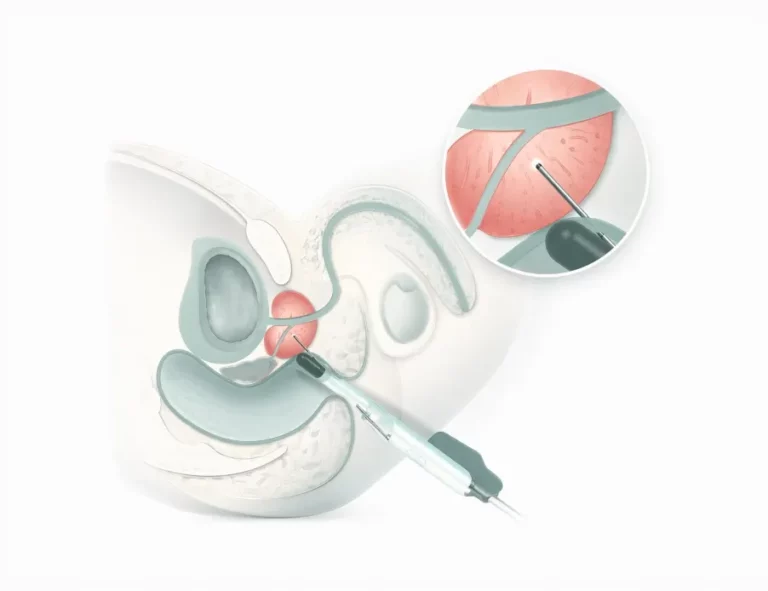
It is especially indicated in patients with elevated or rising PSA, suspicious lesions on MRI or previous negative biopsies with persistent clinical suspicion, and is considered one of the most effective tools for the detection of clinically significant prostate cancer.
The needle is directed straight to the lesion detected on the MRI, reducing errors and increasing the reliability of the result. If the result is negative, there is reassurance that the sample was obtained from the correct area. The procedure is quick, guided, and carries very little risk. low localization error. It is also especially useful in cases with persistent clinical suspicion or elevated PSA.
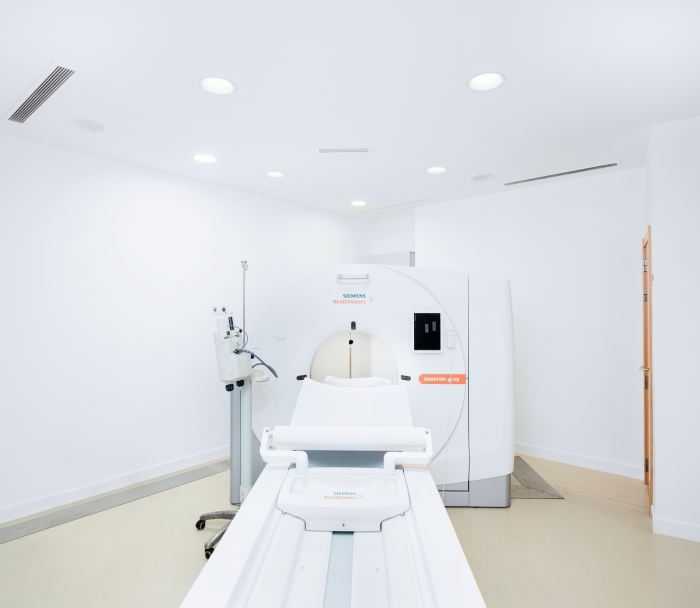
At our clinic we have multiparametric functional magnetic resonance imaging of the prostate, an advanced imaging technology that allows the prostate to be studied with a extremely high level of precision y detect suspicious lesions prostate cancer in very early stages. Thanks to its ability to analyze different parameters of prostate tissue, it offers a much more complete and detailed evaluation than conventional techniques.
This technology provides a more accurate diagnosis, It significantly improves tumor localization and allows for the performance of more accurately targeted biopsies. Furthermore, it helps reduce unnecessary biopsies and plays a fundamental role in personalized treatment planning, facilitating safer decisions tailored to the specific characteristics of each patient.

At our clinic we also incorporate an advanced technology that is not permanently available at any other center in Andalusia: micro-ultrasound, one of the great differentiating elements of our center. This ultra-high-resolution imaging technology offers diagnostic capability comparable to, and even superior to, magnetic resonance imaging in certain cases, making it possible to identify suspicious lesions that may go unnoticed with other techniques. Furthermore, it facilitates the performance of much more precise and targeted biopsies.
Combined with fusion biopsy, micro-ultrasound raises diagnostic sensitivity to the highest level available today. Its main advantages are a greater diagnostic accuracy, a more detailed detection of injuries suspicious and the possibility of acting as a complement or even alternative to magnetic resonance imaging in certain cases. Furthermore, they allow for much more precise biopsies, optimizing the early diagnosis of prostate cancer and improving personalized treatment planning.
We answer all your questions about advanced diagnostic technologies.
The combination of fusion biopsy and micro-ultrasound is currently the most sensitive and accurate technique for detecting clinically significant prostate cancer. This translates into: More reliable diagnoses. Fewer unnecessary procedures. Greater peace of mind for the patient. Improved treatment planning.
One of the greatest benefits for the patient is the confidence in the result. If the biopsy is negative, you can rest assured that the suspicious area has been properly analyzed. This drastically reduces the need for repeat tests and avoids delays in diagnosis and treatment.
Fusion biopsy combines real-time magnetic resonance imaging and ultrasound, allowing the needle to be directed precisely to the suspicious area.
This means:
While conventional biopsies were based on estimates, this technology goes directly to the source of the problem.