
Specialists in Da Vinci robotic surgery for prostate cancer
Da Vinci robotic surgery in Malaga to perform the most complex procedures, such as prostate cancer surgery using a minimally invasive approach.
How our surgeons use Da Vinci robotic surgery
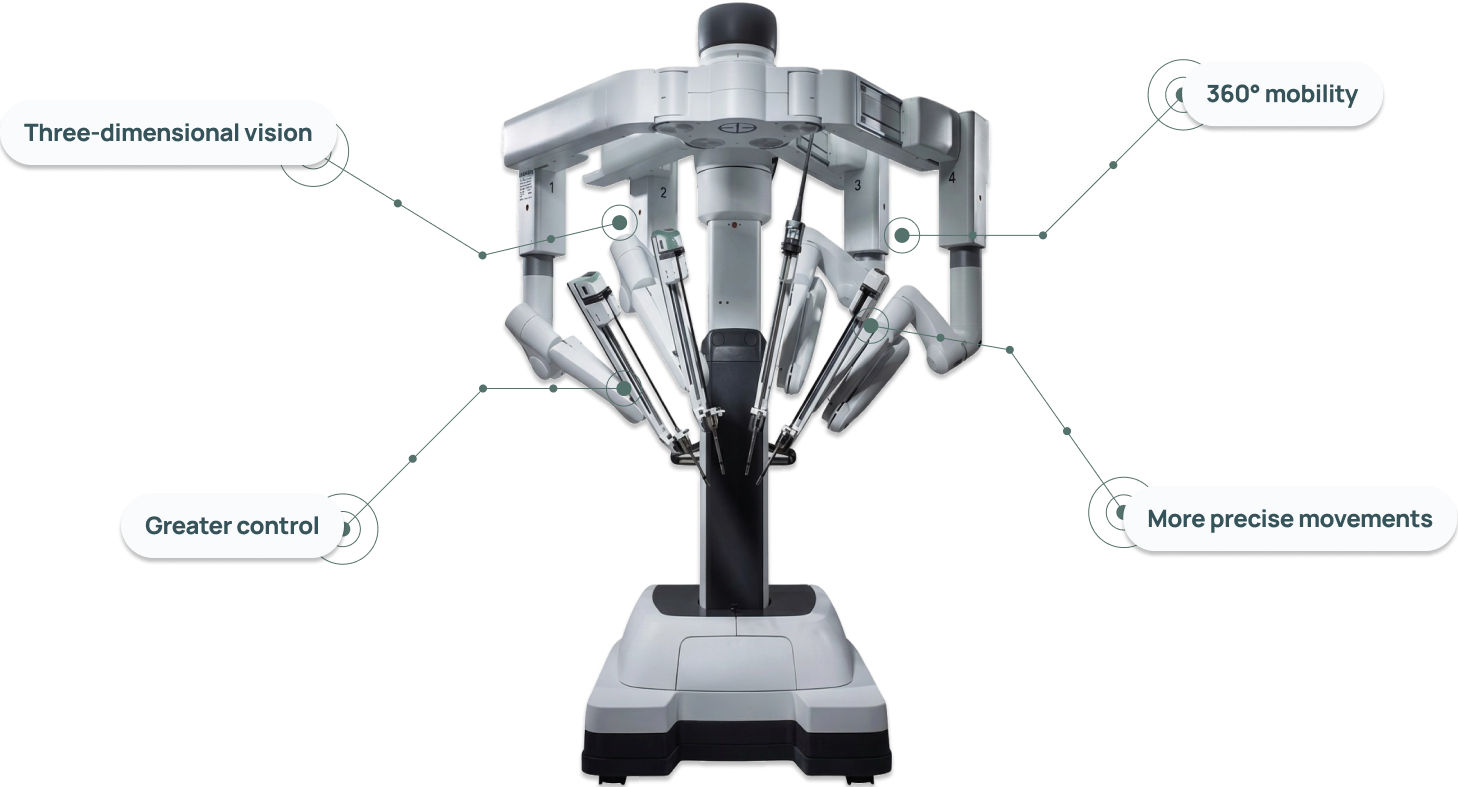
During robotic surgery with the Da Vinci system, the surgeon makes small incisions through which a high-definition 3D endoscopic camera and surgical instruments are inserted.
From a console located in the operating room, the specialist controls the robotic arms, which reproduce the movements of the human hand with greater precision and stability.
90%
Preservation of continence
Two of the side effects of conventional surgeries that cause the most concern to the patient are that sexual function and continence are affected.
Thanks to Da Vinci robotic surgery, the rate of preservation of urinary continence and recovery of erectile function is very high in the vast majority of patients.
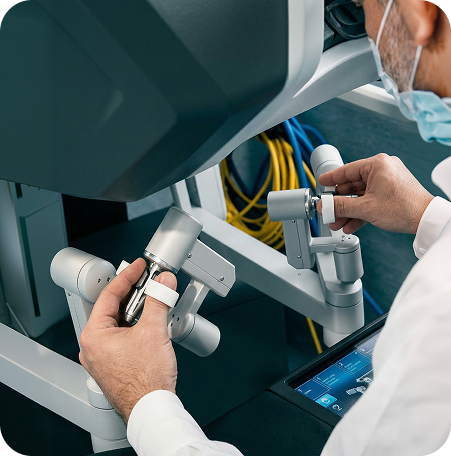
We operate with the most advanced technology in urological surgery.
Our team of urologists, with extensive experience in urological surgery, uses the Da Vinci® system to address complex interventions, especially in the treatment of prostate cancer and other urological pathologies.
This approach allows for minimally invasive surgery, with small incisions and extremely high precision. The surgeon controls the system from the console, guiding the robotic arms with their expertise to achieve millimeter accuracy.
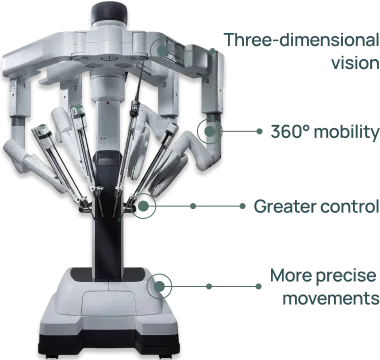
Thanks to its high-definition three-dimensional vision and 360º maneuverability, the Da Vinci system improves surgical precision and reduces the impact of the intervention on the patient's body.
Benefits of surgery performed by specialists using the Da Vinci system
Less invasive
The surgery is performed by small incisions, This reduces surgical trauma. less bleeding, less postoperative pain, and minimal scarring.
Greater security
Because it is a more precise and controlled surgery, it reduces the risks associated with traditional open surgeries, improving the safety of the procedure.
Greater surgical precision
The system offers high-definition 3D vision and a large magnification of the surgical area, This allows for microsurgical movements that are impossible with conventional techniques.
Faster recovery
Patients often experience a faster recovery and a shorter hospital stay. In many cases, discharge can occur between 4 and 5 days after the procedure, compared to approximately 10 days for conventional surgery.
Other areas of application
Large prostates: Generally above 80-100 grams, where transurethral surgery (through the duct) is riskier or longer.
Bladder diverticula: When the patient has "pouches" in the bladder due to the strain of urinating, these also need to be repaired.
Bladder stones (Bladder lithiasis): If the stones are very large and accompany an obstructive prostate.
Partial Nephrectomy: It's the "star" surgery. It allows for the removal of only the tumor and the suturing of the kidney in record time (ischemia time), saving the organ.
Pyeloplasty: Correction of the narrowing of the junction between the kidney and the ureter.
Ureteral Reimplantation: When the ureter is damaged or narrowed and needs to be reconnected to the bladder
Nephroureterectomy: Removal of the kidney and the entire ureter in cases of urinary tract tumors.
Radical Cystectomy: Bladder removal due to cancer.
Creation of Neovejiga: The robot allows a "new bladder" to be manufactured using a piece of the patient's own intestine without opening the abdomen.
Diverticulectomy: Removal of sacs or pouches that form in the bladder wall.
Vesical Fistulas: Repair of abnormal communications between the bladder and the rectum or vagina.
Salvage lymphadenectomy: Cleaning of affected lymph nodes when cancer has recurred, with a precision impossible in open surgery.
Simple prostatectomy (Adenomectomy): As we mentioned, for cases of large benign growth (BPH).
Frequently Asked Questions
Everything you need to know about Da Vinci robotic surgery.
Who is the ideal candidate for robotic prostate cancer surgery?
Generally, men diagnosed with early-stage prostate cancer They may benefit from this type of surgery, although each case should be evaluated by a urology specialist.
Is the operation performed by the robot or the surgeon?
The surgery is always performed by a specialized surgeon.
The Da Vinci robot does not operate autonomously, but rather acts as an advanced tool that It more accurately reproduces the surgeon's movements. and improves their ability to see and control during the procedure.
Does robotic surgery have risks?
As with any surgical procedure, there may be risks such as bleeding, infection, or reactions to anesthesia. However, since it is a minimally invasive and more precise surgery, The Da Vinci system helps to significantly reduce the likelihood of complications.
What is the difference between robotic and laparoscopic surgery?
In the laparoscopic surgery, The surgeon handles rigid instruments and visualizes the intervention on a two-dimensional monitor.
With the Da Vinci Robot, The surgeon has enhanced three-dimensional vision, full mobility of the instruments, greater precision in movements, and better access to complex areas.
This allows interventions to be carried out with greater accuracy, less invasiveness, and better results for the patient.
What procedures can be performed with the Da Vinci robot?
- Robotic radical prostatectomy
- Robotic prostatectomy combined with other procedures
- Robotic radical nephrectomy
- Robotic partial nephrectomy
- Nephrectomy with lymphadenectomy
- Robotic nephroureterectomy
- Robotic radical cystectomy
- Cystectomy with lymphadenectomy
- Radical cystectomy with intracorporeal urinary diversion
- Robotic supraadrenalectomy
- Robotic pyeloplasty
- Ureteral reimplantation (ureterocystoneostomy)
- Robotic unilateral ureterocystoneostomy
- Laparoscopic cutaneous ureteroileostomy